Toyota Raises Its Forecast as North America Climbs Back Into Profit
Toyota raised its full-year operating profit forecast to 3.9 trillion yen on Thursday after North America swung from a loss to a profit in the first half of its fiscal year.
Toyota raised its full-year operating profit forecast to 3.9 trillion yen on Thursday after North America swung from a loss to a profit in the first half of its fiscal year.
The increase is 500 billion yen over the August forecast.
The new forecast is roughly $24.8 billion at the 157 yen to the dollar that Toyota now assumes, and it would be the first year-over-year increase in annual operating income since the fiscal year that ended in March 2024. Net income for the year ending in March 2027 is now forecast at 3.57 trillion yen instead of 3.25 trillion yen, even as Toyota trimmed its revenue forecast by 500 billion yen to 53.5 trillion yen on weaker sales in China.
The numbers come from the financial summary and results presentation Toyota posted in Tokyo on November 5, which was late Wednesday night in the United States. For the July-to-September quarter, revenue rose to 13,437.0 billion yen from 12,377.4 billion yen a year earlier, and operating income climbed to 1,127.6 billion yen, about $7.1 billion at the 159 yen rate Toyota reported for the period, from 839.5 billion yen. That is a gain of 288.1 billion yen, or 34 percent, and the first year-over-year increase in six quarters. Net income went the other way, falling to 759.4 billion yen from 932.0 billion yen, because other income swung to a 137.1 billion yen loss from a 386.4 billion yen gain, a line made up of investment and financial items rather than car sales.
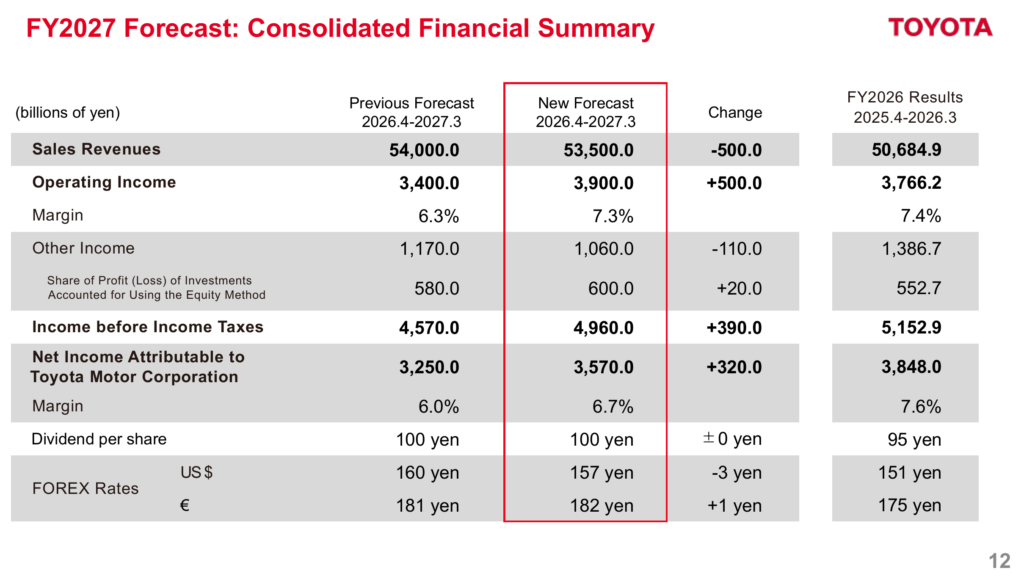
For the first half, April through September, revenue was 26,962.4 billion yen, up 9.5 percent, operating income was 2,191.1 billion yen, up 9.2 percent, and net income was 2,236.4 billion yen, up 26.1 percent. Toyota credited a weaker yen for 685 billion yen of the first-half gain and improvement efforts, which it defines as pricing, cost cuts and higher parts and finance earnings, for another 165 billion yen, while higher materials prices cost it 465 billion yen, including 125 billion yen tied to the situation in the Middle East. Toyota did not put a figure on US tariffs this time, but Takanori Azuma, the chief officer of its accounting group, said in his prepared remarks that the company captured "the mitigation of the impact of U.S. tariffs" alongside the currency gain.
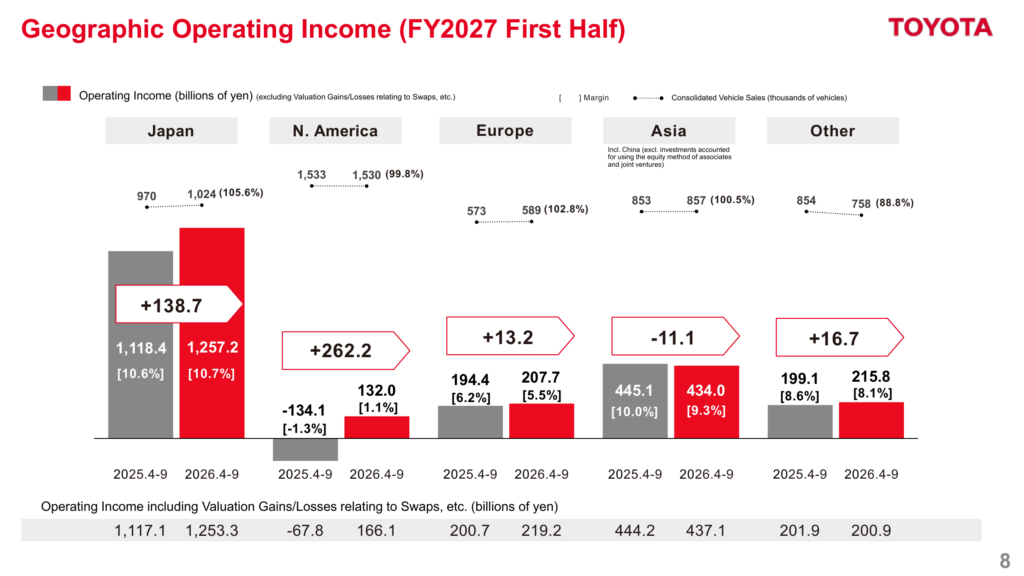
North America is the part of the report that matters most for buyers here. The region earned 166.1 billion yen of operating income in the first half, compared with a 67.8 billion yen loss a year earlier, on revenue that rose 13.9 percent to 11,922.1 billion yen. Excluding swap valuation gains, the figure Toyota uses in its regional chart, the swing was from a 134.1 billion yen loss to a 132.0 billion yen profit, a margin of just 1.1 percent against 10.7 percent in Japan. Toyota said North America "returned to profitability largely due to price revisions and the reduced impact of U.S. tariffs." Consolidated North American vehicle sales were flat at 1.53 million, and the full-year forecast for the region slipped to 3.0 million from 3.02 million. In the July-to-September quarter alone, the region was barely above break-even on the ex-swap basis at 6.7 billion yen, compared with a 70.4 billion yen loss a year earlier.
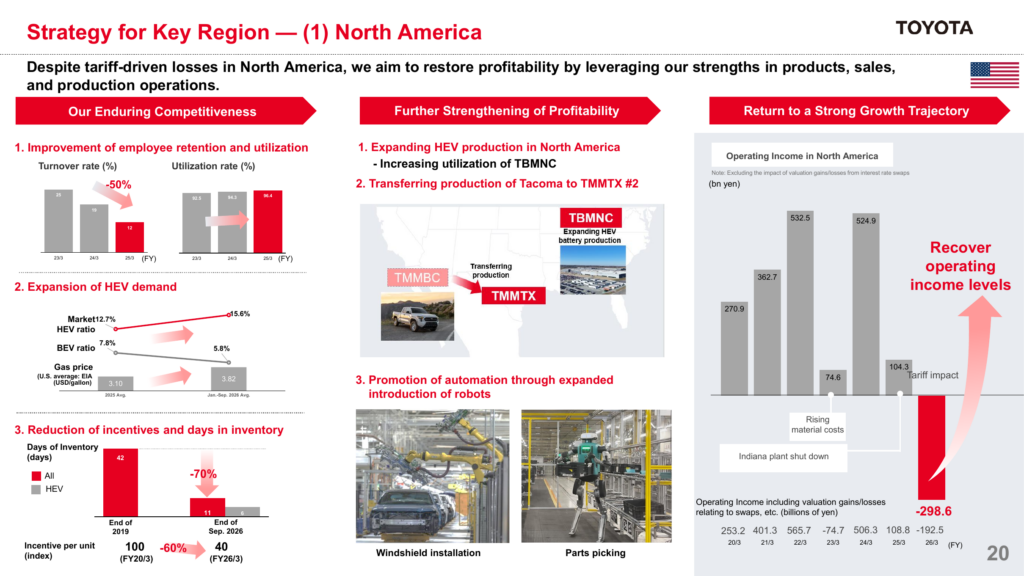
Executive Vice President Yoichi Miyazaki, Toyota’s chief financial officer, used the briefing to show where the US money is going next. The plan has three parts: expanding hybrid battery output at Toyota Battery Manufacturing North Carolina, moving Tacoma production from the Baja California plant in Mexico to a second line at Toyota Motor Manufacturing Texas in San Antonio, and putting more robots on the line for jobs like windshield installation and parts picking. The slide behind him showed why the hybrid push comes first: hybrids took 15.6 percent of the US market from January through September 2026, up from 12.7 percent in 2025, as the average gasoline price rose to $3.82 from $3.10, and Toyota’s US dealers were holding just 11 days of inventory at the end of September, six days for hybrids, with incentives per vehicle at 40 percent of their 2019 level. "Although regional earnings for the fiscal year ended March 2026 fell into the red due to the impact of tariffs, underlying strength has enabled a recovery to profitability in the second quarter," Miyazaki said.
Global sales told a weaker story. Toyota and Lexus retail sales fell 4 percent in the first half to 5.06 million, which Toyota blamed on China and the Middle East, and the China figure dropped to 685,000 from 914,000. The full-year retail forecast was cut to 10.3 million from 10.5 million for the same reason, while the consolidated forecast held at 9.7 million. Electrified vehicles made up 55.6 percent of first-half sales, up from 46.7 percent, with hybrids up 8.3 percent to 2.45 million, plug-in hybrids up 33.2 percent to 130,000 and battery electrics more than doubling to 231,000. Hino Motors is no longer consolidated, which took 51,000 vehicles out of the year-earlier comparison.
Shareholders get more as well. The interim dividend is 50 yen a share, up 5 yen, with the full-year forecast at 100 yen, and Toyota added 300 billion yen to its buyback authorization for a fiscal-year total of up to 1.3 trillion yen. It will also cancel another 1 billion treasury shares, bringing this year’s cancellations to 1.2 billion shares worth roughly 3.5 trillion yen at end-of-September prices, and it put its total shareholder return ratio for the year at 69.4 percent. Over the next five years Toyota plans 22 trillion yen of capital spending, research and growth investment and 11 trillion to 14 trillion yen of shareholder returns, with 7 trillion yen of net liquid assets held back as a reserve.
Miyazaki also confirmed that a new company-wide organization called Toyota Robotics will launch on January 1, 2027, built on what Toyota estimates is internal demand for 400,000 robots across the group and its suppliers between 2028 and 2040 and about 1 trillion yen a year of spending to replace aging factory equipment. And he promised product news without naming any of it, saying each of Toyota’s five brands "has gone all out to ready an incredible array of models we believe will draw cries of ‘Wow!’"
The Toyota Report Take
The headline is the raised forecast, but the number American shoppers should notice is that 1.1 percent North American margin. Toyota got back to profit here by raising prices and holding inventory to eleven days, not by selling more cars, and it is telling investors the next step is more hybrid batteries from North Carolina and a Texas-built Tacoma. That is a company planning to keep supply tight and incentives low on exactly the vehicles people want most, so anyone waiting for RAV4 Hybrid or Tacoma discounts to loosen up after a strong quarter should read this report as a reason not to. The upside is that the money is being spent in Texas and North Carolina rather than in Mexico, and the Tacoma move in particular is the clearest sign yet that Toyota has decided the tariff era is permanent enough to build around.
Related
The Crown Signia Limited Gains $1,865 in Tech and Costs $2,065 More
The 2027 Toyota Crown Signia Limited, announced on October 22, includes the Advanced Technology Package as standard equipment, and its price rises $2,065 to $51,155 before the $1,595…

Toyota Trades Wheels for Snow Tracks on Five SEMA Concepts
Toyota brought a Tundra, a Tacoma, a 4Runner, a Land Cruiser and a Sequoia to the 2026 SEMA Show with their wheels replaced by snow tracks.

Toyota Even Lifted the Minivan for Its SEMA Woodland Family
Toyota brought lifted, all-terrain versions of the Sienna, RAV4 Plug-in Hybrid, Grand Highlander, bZ and Crown Signia to the 2026 SEMA Show as a new family of Woodland…
Comments (0)
Join the discussion