Toyota Leads a Push to End Japan’s 70,000 Kinds of Wiring Harness
Japan's carmakers have agreed to start writing shared standards for three things that go into almost every car they build: steel, plastic resin and wiring harnesses.
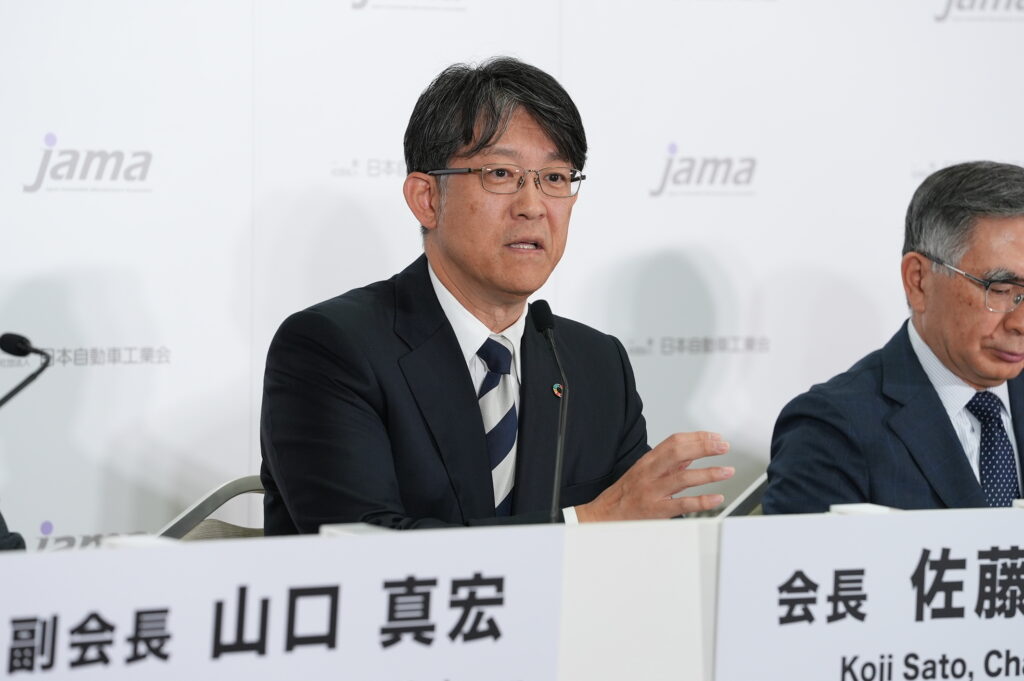
Japan’s carmakers have agreed to start writing shared standards for three things that go into almost every car they build: steel, plastic resin and wiring harnesses. The plan was laid out in Tokyo on Wednesday, November 19, by the Japan Automobile Manufacturers Association, the industry group now chaired by Toyota vice chairman Koji Sato, and Toyota managers are running the effort.
The three items were picked because of what they cost. Steel and resin make up a large share of the cost of bodies, exteriors and interiors, while wiring harnesses are still largely assembled by hand, their cost is rising, and the association’s members use about 70,000 different kinds of them around the world.
The association set out the plan in a press conference summary and a set of briefing slides from its supply chain resilience task force. The task force is led by Keisuke Honma, who heads the association’s procurement committee and comes from Toyota, and its wiring harness team is led by Toyota’s Koji Nomura. Mazda’s Yasuhiro Shibuya leads the steel team and Subaru’s Seigo Shimizu leads the resin team, and leaders from the Japan Auto Parts Industries Association, from Toyoda Gosei and Yazaki, sat on the same panel.
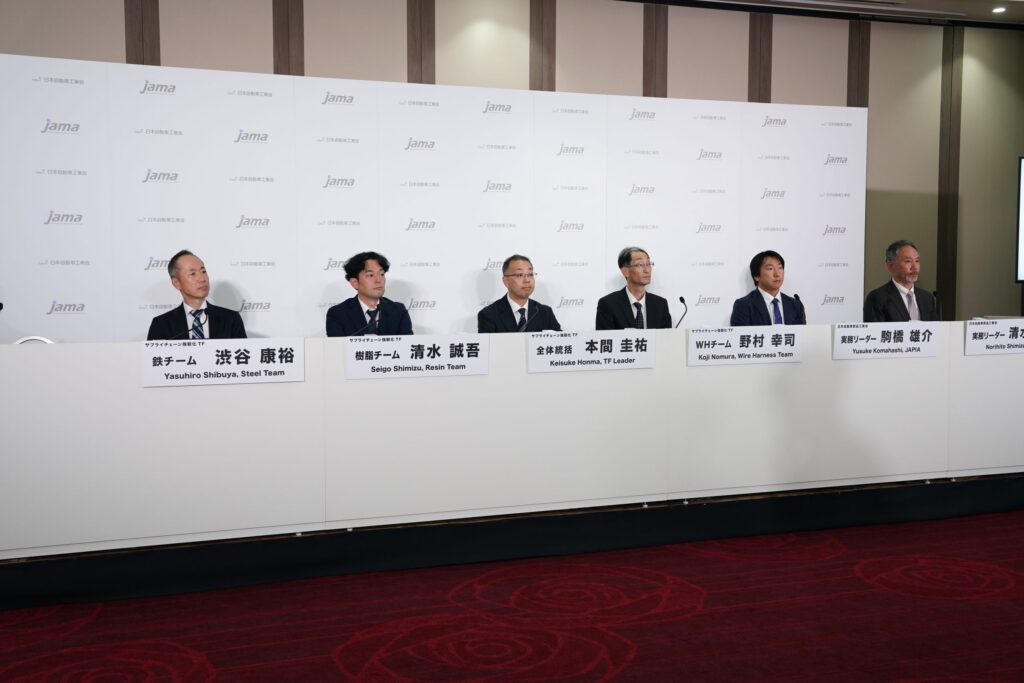
Honma framed the work in blunt terms. He listed a shrinking workforce, a rising share of exports, the weak yen and the spread of trading blocs as pressures on the Japanese industry, and said it needed an effort in which its survival was at stake. He also said the companies would proceed with close attention to antitrust law, and that cooperation was not the goal in itself but a way to make each company more valuable and competitive.
What Changes in Each Material
The steel team has three near-term jobs. It wants to consolidate materials that are made only in small volumes, to unify the slightly different extra requirements each carmaker adds on top of the Japan Iron and Steel Federation’s standards, and to settle on one set of quality evaluation standards in place of each company’s own.
The resin team is starting with recycled plastic. It plans to keep more recycled material circulating inside Japan, to unify the quality standards, evaluation methods and materials used for recycled resin, and to work with the chemical industry on low-carbon materials.
The wiring harness team works under a slogan of "ONE OEM" and has begun on three tasks. The first is wider use of aluminum wire in place of copper, which is in short supply, with fewer types of wire and a single evaluation standard. The second is a single set of rules where every company now does something a little differently, and the team gave two examples: the shade of orange used to mark high-voltage cables for mechanics and first responders, and the force needed to push a connector home. The third is automation, so that suppliers can build harnesses by machine near the factories they serve rather than by hand.
The slides set two time frames. A short-term phase of about three years covers vehicles already in production, and a medium-to-long-term phase of five to 10 years covers new models. Items that prove too hard to settle across the whole association may instead be handled between individual companies, and the task force said further items will be added until the work covers the whole car, along with shared technical evaluation methods and design tools.
What Sato and Rivals Said
At the same event, Sato reviewed the association’s year and announced that the next Japan Mobility Show will run for 11 days at Tokyo Big Sight, from October 28 to November 7, 2027. In questions, he was asked whether shared parts would make Japanese cars less distinctive. According to Best Car Web, Sato said that making standards must not become the main purpose, and that the companies compete first. Honda president Toshihiro Mibe said customers do not see parts such as the routing of a harness, so that area can become common and the savings can go into what buyers do see. Suzuki president Toshihiro Suzuki said materials should be standardized before parts, which would also make recycling easier.
The association did not put a figure on the savings, and it has not said whether the new standards will apply at its members’ plants in North America, although the 70,000 harness count it gave covers its members’ operations worldwide.
The Toyota Report Take
Seventy thousand kinds of wiring harness is the number that explains this whole effort. Every one of them has to be designed, tested and largely built by hand, and none of that work makes a Camry or a Civic better to drive. Japan’s carmakers have talked about sharing hidden parts for decades without much to show for it, so the useful thing here is the detail: named teams, named items, a three-year horizon, and examples as small as the color of a cable. If it works, the payoff for buyers is indirect but real, in the form of engineers and money freed up for the parts of a car people actually notice. The open question for US buyers is whether any of it crosses the Pacific to the plants that build Toyotas for America.
Related

Scion’s Little Electric Two-Wheeler Folds Into a GR86 Trunk
The smallest vehicle in the revived Scion lineup is an electric two-wheeler that folds in about 30 seconds to fit a GR86 trunk.

Toyota’s Smallest SUV May Grow a Third Row
The next Toyota Raize could come in two sizes, with a stretched seven-seat version arriving alongside the regular five-seater when the compact SUV is redesigned, which is reportedly…

Toyota’s Newest Takata Recall Is Mostly Old Corollas
Nearly three of every four vehicles in Toyota's latest Takata airbag recall are 2003-2008 Corollas.
Comments (0)
Join the discussion